


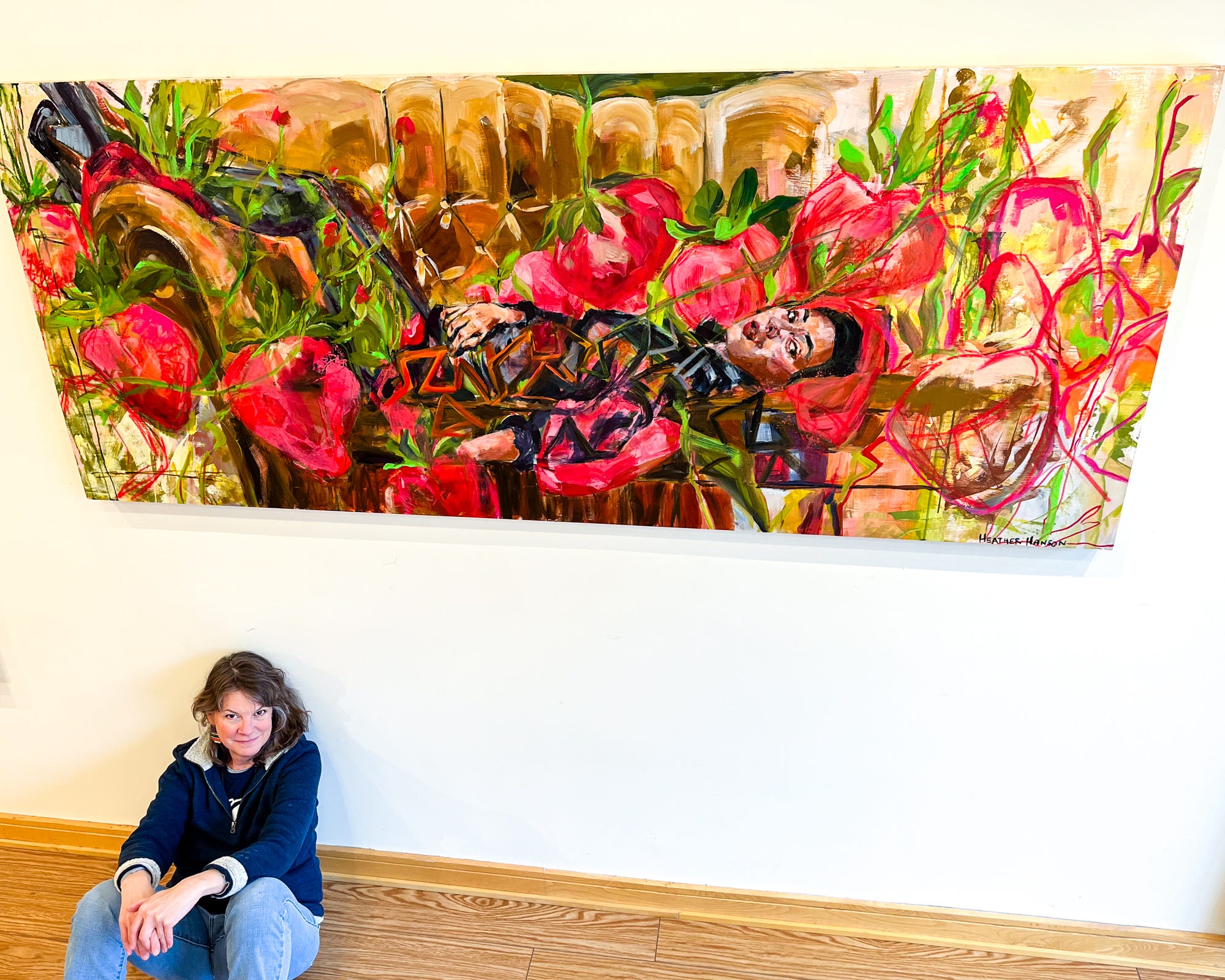
I didn’t know what this painting would be until the strawberries went in.
I had the figure. I had the gold sofa. I had the lush reds already moving across the surface — root energy, grounded passion, the kind of color that lives in the body before it lives in the mind.
But the ground came first.
We had driven up to Grand Marais. North Shore. The rocks, the water, the vegetation, the particular quality of light on Lake Superior in that season. I am from the South. My husband is from here. After the flood took everything in Asheville, we chose Minnesota. We chose this ground.
That choosing lives underneath the painting. Literally. Nobody will see it when they stand in front of her. But it is there. The way the work you do on yourself is there, even when it doesn’t show.
That foundation mattered before anything else could.
—
And then: a gold sofa.
That image arrived before I touched the canvas. I carried it — the reclining figure, the lushness, the sense of invitation without urgency. Not performing. Not waiting to be chosen. Simply being, fully, in her own space.
Sensual without apology.
When the strawberries layered over her, something became clear. She grew from this. The vines, the leaves, the strawberries in outline — rugged, raw, not yet finished into something the world would recognize — they are not decoration. They are the inner work made visible. The root system she built. The self-knowledge that came slowly, at cost, over years. She is the result of all of it. Reclining within her own ground. Held by what she did to become herself.
The strength I wrote about in the last post — the backbone deep enough to make room for another — this is what it looks like.
—
The Hetaira is the only horizontal painting in the series.
Every other canvas reaches upward. The Amazon moves through a doorway. The Mother, grounded as she is, has height. Even the Medial Woman holds a vertical stillness.
The Hetaira reclines.
She is not reaching. She is not ascending. She is here, present, occupying the full width of the space she is given.
—
I worked the edges loose on purpose.
The sides of the canvas stay unresolved. Less formed, more open. The detail gathers as you move toward her. She earns your attention gradually.
The marabou crayon marks in the reds and pinks — lipstick-like, quick — are that rawness made visible. Not quite becoming. Not meant to be fixed into final form. There is a malleability here. The Hetaira is never fully finished. Neither was I, making her. We were both still in the forming.
That felt true to leave in the work.
—
The jagged elements are there too.
They live in her midsection. Right at her center.
I didn’t soften them. I didn’t resolve them into the lushness around them.
A garden holds difficulty naturally. Thorns are not damage. The jagged marks belong the way rock belongs underneath soft soil. Not a wound separate from the beauty. Part of what makes the beauty true.
—
I spent years looking at this archetype with something close to contempt.
The softness. The need. The orientation toward another.
What I misunderstood, for a long time, is that the Hetaira’s power begins inside herself.
The reclining figure on the gold sofa is not waiting for someone to arrive. She is already rooted. Already present. Already whole enough in herself that she becomes capable of genuine invitation. Not performance. Not need. Not shape-shifting into whatever another person requires.
From that ground, she can truly orient toward another.
Not before.
And from that place — only from that place — there is room for another.
—
She is lush. She is not finished at the edges.
And right at her center, the jagged marks remain.
That feels true to me.
Next: the poem.